Karen’s official book launch was this Saturday–a quiet signing at Breakwater Books in Guilford, Connecticut.
And damn it, I just had to be there.
I decided not to tell her I was coming, for two reasons: 1) I thought it would be fun to surprise her, and 2) If I had to back out at the last minute, I didn’t want to screw up her plans.
God bless my crazy friend who offered to tag along and ended up driving nearly the whole six hours from DC (I get a tad nervous in that NYC snarl, but she drives like a machine).
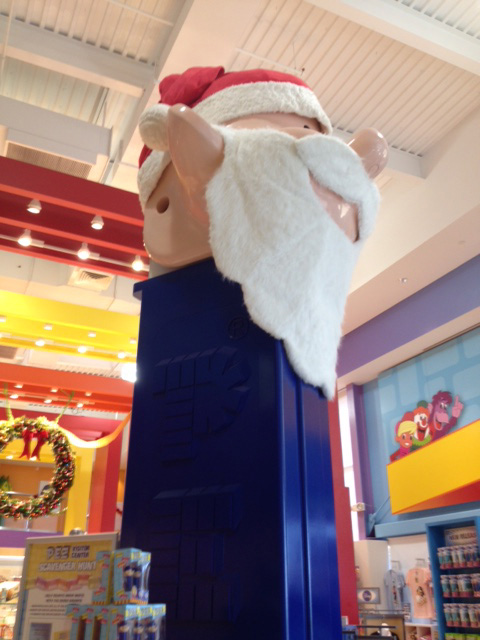
Much zaniness along the way, including a stop at the Pez Visitor Center. Yes, that’s the candy that pops out of the heads. Did you ever wonder what the World’s Largest Pez dispenser would look like? Wonder no more.
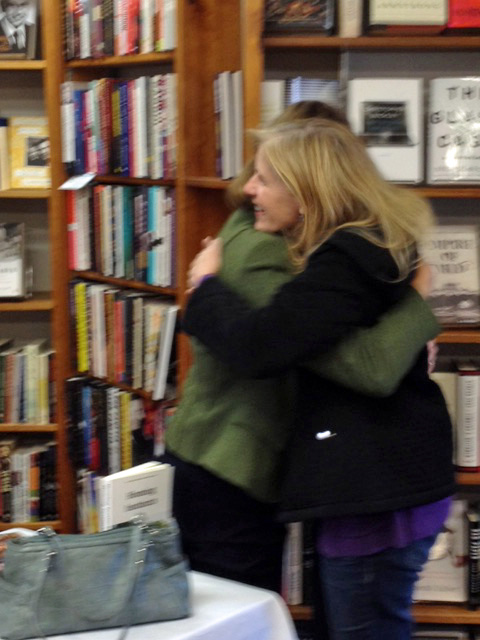
So anyway, we finally made it to Connecticut and headed for Breakwater Books. Now keep in mind that, although Karen and I talk via electronics frequently, we hadn’t seen each other in person in EIGHT years.
So I walked in, and this happened:
Fun, right? I thought so.
Karen invited us back to her lovely home afterward, and we all had breakfast with her husband and son the next morning, then hit the road before the snow started. Here we are outside the cafe at Lyman’s Orchard (a way cool farmer’s market store):
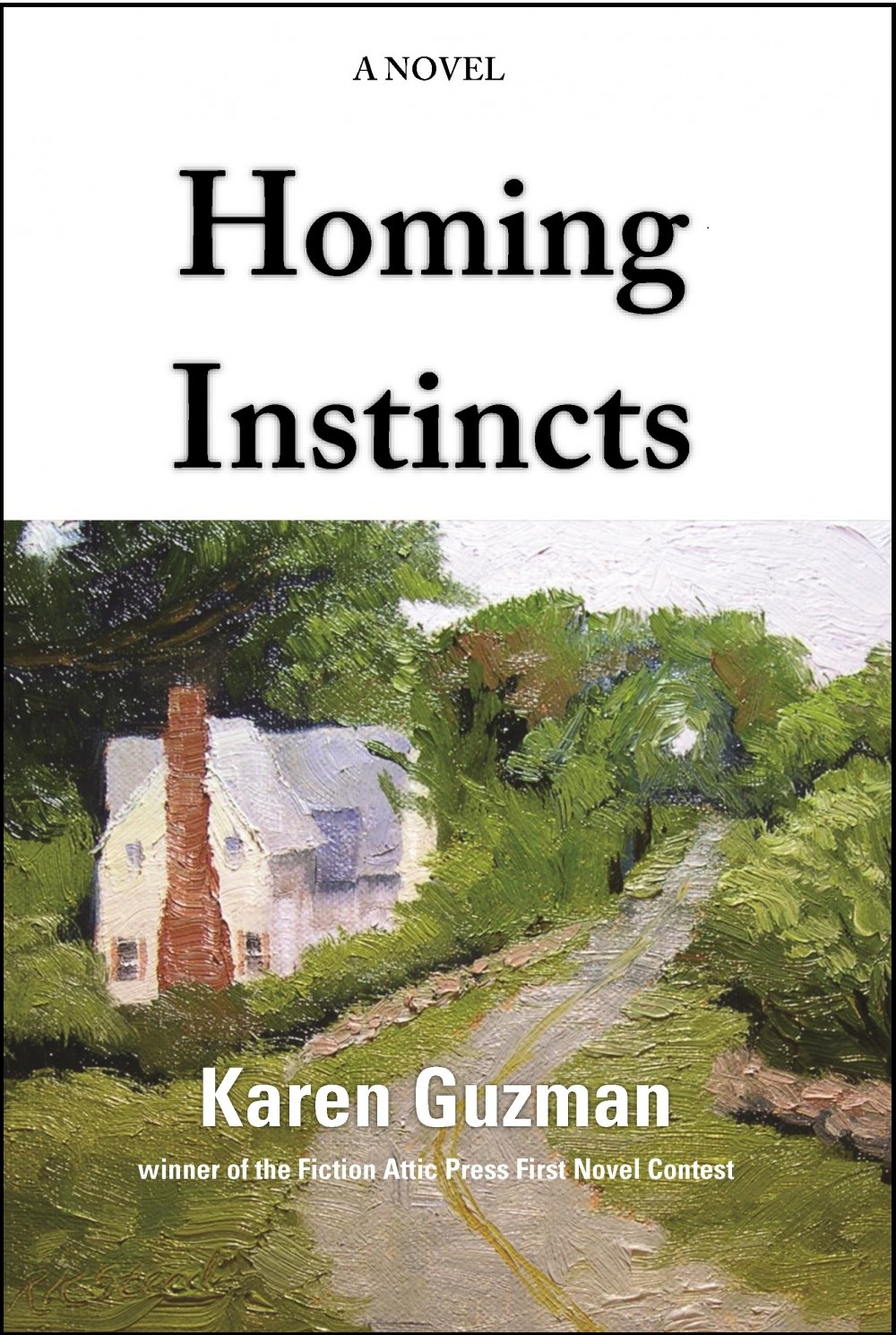
The whole trip was way cool, and I’m so glad I was able to do it. This Saturday Karen will be giving her first reading in Mystic, CT. If you’re local (or if you’re into crazy road trips), go get a book signed and hear her read from Homing Instincts. You won’t be disappointed.
Congratulations, Karen! Hope to see you again before another eight years passes!
I want to thank the entire Write Despite community for your enthusiasm and support. Reach out and let me know how you like the book and if there’s anything I can do to help you along your writing journey!
This book has been a labor of love and learning for me. Never thought I’d see the day when it was in print. Miracles do happen, folks. I’m living proof.
Please check my site regularly for scheduled readings and other news. Send me your comments and questions, too.
There is something to be said for that stubborn streak your parents always complained about. “Muleheaded” was, as I recall, my parents’ fave term. That trait has gotten me into more than a few fights and through plenty of standoffs with my kids, and into a fair amount of trouble. It’s also gotten me published a few times. Here’s the thing with stubbornness: You can fall back on it when you really, truly believe you’ve got a winner. I wrote a story I loved way back in 1993. Yes, I’m old, okay? Let’s move on. In its early days, it went through workshops, incarnations, edits, and reviews by trusted friends. It tentatively made its way into the world and got rejected plenty. Then it sat in a drawer for about a decade and a half until I rediscovered it one day and decided it was worth another try. Back to editing and begging friends to read it. And cutting! This story is still nearly 6,500 words, but it used to be a whopping 8,000, until a writer friend gently suggested “You have got to CUT some of this bullshit.” So I did. In the last four years I’ve sent it out pretty regularly to more than 50 different magazines and journals. This month…drumroll here… It worked! I’m a finalist in New Rives Press’s American Fiction series! (Yes, that’s my big ol’ face right there at the top—so embarrassing.) All the finalists get published in the latest issue, along with three top prize winners judged by…drumroll again… Elizabeth Strout.Elizabeth Strout! Pulitzer Prize winner! Olive Kitteridge creator! Reading MY story! I’m a wee bit excited about this one if you can’t tell. So my point is, stubbornness. And a real willingness to listen to what others have to say and make the hard changes you have to make. The American Fiction prize winners will be announced by late September. And I was thrilled to see the publication date is October…a mere three months away! Then I realized it is actually October…2015. Ah well. After 21 years, what’s one more? Write well everyone―keep submitting! ―Cathy
Sorry for the lateness in posting.Remember when summers used to mean long, lazy days with nothing to do but read, run, play, hang by the pool?
Yeah, we barely recall that either. And even if we did, it’s a far cry from what we’re doing now, right? Here at Write Despite, we’ve been a wee bit busy. Karen is working on securing final changes and cover art (fun!) for her novel, which comes out this fall. I’m submitting, submitting the same story again and again and drumming up a very slow start to a new short story. Oh, and using every ounce of my energy to ignore my novel rewrite number 580,026. Hopefully we’ll have more on both of those later.
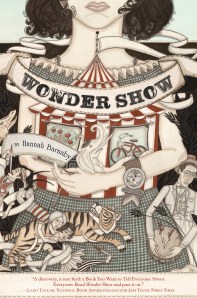
In other news, we’d like to announce the winner of the Hannah Barnaby book! Writingfamily is the winner of Wonder Show and will be receiving her copy shortly. Thanks to everyone who chimed in with comments.
Hope you’ve all been able to write up a storm this summer despite the kids being home, the sun calling you outdoors and vacations giving you a well-deserved break from the routine. If you’re struggling to fit writing into your days, remember our mantra here at WD:
It’s only 20 minutes!
Yeah, we know. But still, write well everyone, and enjoy your summer!
Hannah Barnaby is author of Wonder Show, anovel set in 1939 that tells the tale of 13-year-old Portia Remini, who flees a Home for Wayward Girls and winds up with a traveling sideshow. As if the freakish world of the carnival and its sideshow “misfits” aren’t enough to deal with, Portia’s also searching for the father who abandoned her, and keeping a constant watch for Mister, her old headmaster, whom she’s certain will someday find her.
Wonder Show was a 2013 William C. Morris YA Debut Award Finalist and a Children’s Book of the Month Club pick. It was also named to the YALSA Best Fiction for Young Adults List, the Bank Street College’s Best Books List, and the School Library Journal’s Best Books List, and it was an IndieBound New Voices Selection.
Hannah Barnaby
Intrigued? Offer up a comment to Hannah’s interview with Write Despite, below, and you could win a free, signed copy of Wonder Show.
This is your first book, correct? Why did you choose to write YA and is it the genre you plan to continue with?
Wonder Show is my first published novel, but not the first that I wrote. I have a middle-grade story that I wrote during my MFA program at Vermont College, that novel-in-the-drawer that most writers have. I’m not sure if it will ever be resurrected, but it taught me about the building blocks of a novel and about my own process.
As for choosing to write YA, I actually work pretty hard not to think about genre while I’m writing. Some genres—picture books, for instance—are obvious designations and have their own rules, but the lines between others—like middle-grade and YA—are not as clear. When Wonder Show was first published, it was named to the middle-grade summer reading list for the Children’s Book of the Month Club. Then it was nominated for the William C. Morris Award for debut young adult novels. So there was no hard and fast label for the book, which I appreciated because it reflected the fact that the audience for Wonder Show could be wider than one group of readers.
Your website says you came up with the character of Portia Remini in a dream, but what drew you to write about the circus, and its sideshow “misfits” in particular?
When I set out to write Wonder Show, all I had was the image of a girl riding a bicycle on a dirt road, and the sense that she was running away from somewhere. I didn’t know where she was going or who she was running from or anything else, really. Then a friend told me about a grant offered by the Boston Public Library, the winner of which would get financial support as well as being named the Children’s Writer-in-Residence. I decided to apply, and in researching the library’s Special Collections, I found that they had an archive of circus materials and quite a few books on circus and carnival history. A few months later, I won the grant! And then I was faced with actually writing the project that I’d proposed, which became Wonder Show.
The shifting POV among your characters comes later in the book, and gives it an unexpected twist. Was it fun to switch gears this way, and what made you decide to use this technique?
I wrote the first draft of Wonder Show very much by instinct. When I sat down to write each day, I took a few minutes to think about Portia and where she was and who she was with, and then I started to fashion a scene that built that atmosphere. It wasn’t plot-driven writing at all, but it was very much character-driven, and so I needed to get to know the supporting cast better. Writing pieces of narrative from each different point-of-view gave each character a turn to speak to me and let me know who they were and how their stories intersected with Portia’s. I wasn’t sure about keeping these pieces in the final manuscript, but I came to love them and what they revealed about the sideshow family. (I will say, however, that writing without regard for plot or chronology made the revision process *extremely* challenging. I don’t recommend this method.)
Can you talk a bit about your road to publication?
My path to publication is very different than that of most other writers, because prior to becoming a writer I worked as a children’s book editor at Houghton Mifflin, and winning the grant from the BPL also put me in contact with some valuable allies. One of the judges who awarded me the grant was Melanie Kroupa, who then had her own imprint at FSG. A couple of years after I finished my residency, Melanie wrote to ask, “What ever happened with your novel? Can I read it?” I asked for some time to do a quick revision (six weeks!) and I sent it off. Melanie didn’t end up acquiring the project, but her request got me working on the manuscript again and eventually Kate O’Sullivan, a friend and former colleague at Houghton, offered me a contract.
Do you write every day?
I aspire to write every day, but I rarely do. The reality is that I have three kids, only two of them are in school full-time, and life is unpredictable. So most of all, I try to be flexible. I might steal 20 minutes of writing time while my daughter’s in ballet class or while I’m supposed to be folding laundry. When I can plan for larger blocks of writing time, I always plan ahead so I know what to work on as soon as I sit down. I always, always have a notebook and pen with me because you never know when an new idea will come or the solution to a problem will make itself clear. (And my kids are always saying the most hilarious things, so I can capture those, too.)
What advice do you have for other writers still struggling to create or publish?
Writing is HARD WORK. And the fact that it’s hard doesn’t mean you’re doing it wrong—it means that it’s important and complex and full of emotion, as all good writing should be. Take the time to find the process that works for you, and know that your process will adapt and change from project to project. When I started writing Wonder Show, I was a single, working professional living in Boston. By the time I finished the novel for publication, I was married with children and living in the Connecticut suburbs. My perspective had evolved, and it deepened my writing and my understanding of the creative process.
What are you working on now?
I’ve just completed a contemporary YA novel that’s going out for submission soon (wish me luck!). This summer, I plan to work on a younger chapter book and a few picture book manuscripts—I’m giving myself permission to loosen up my schedule and play with writing more than I usually do. I’ll let you know how it goes!
And by the way, if you’re anywhere near Richmond, Virginia, on Wednesday, June 18, 2014, Hannah will be reading at the Girls of Summer Reading Party at 7 pm at the main branch of the Richmond Public Library, 101 East Franklin Street, Richmond, VA. She will be reading with Meg Medina and also author Gigi Amateau, another ‘Q&A Book Giveaway’ author previously featured on Write Despite. Go if you can!
AND DON’T FORGET: YOU COULD OWN A FREE COPY OF WONDER SHOW. JUST TELL US WHY YOU’D LIKE TO OWN THIS BOOK BY POSTING YOUR COMMENT HERE.
I just read this amazing essay by author Rupert Thompson on The Atlantic website. He covers a lot of ground, and it’s all so important.
A taste:
“To me, a first draft feels like a journey in two directions. On the one hand, it’s like driving along a motorway at night with no headlights: you can crash, you take wrong turns, it’s dangerous, you don’t know where you’re going to end up. At the same time, it’s like going down a mineshaft into yourself, as deep as you possibly can. Those things—covering ground and diving deeper—seem to happen simultaneously when you write a first draft.
It’s a frightening process—I seem to go through a place with every book where I wonder if I’ve wasted all my time, if the idea is totally flawed, and I’ll never bring it off. But the same way that “love entertains its own discriminations,” creativity does, too: You have to trust your instinct and your intuition. If you don’t, then every decision that you ever make is going to have to be rational. That’s impossible. Every page of a book has a million decisions on it, so if you don’t trust your intuition, you’re lost, you’re hamstrung.”
Invest 10 minutes and read the whole thing. You’ll be glad you did.
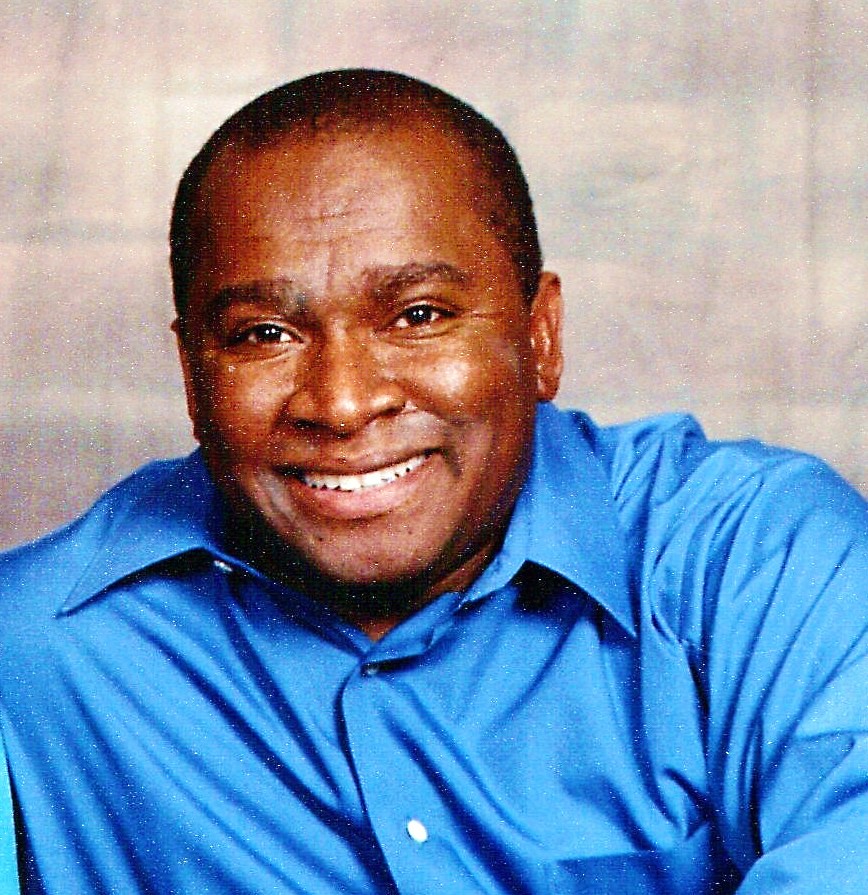
Novelist Mark Lowery, a man of talent and faith, shares his journey to publication with us today. Mark’s debut novel, He Promisd Nvr 2 Leav Me, was published by Lion’s Roar Press, a new Ohio-based independent press. Please check it out and pick up copy.
Born in the Bronx, New York, Mark is an award-winning journalist. He’s reported and edited for national magazines and major newspapers, including Newsday, the Detroit Free Press, and The Plain Dealer. He lives near Cleveland, Ohio.
He PromisD Nvr 2 LeaV Me tells the story of Taran Johnson, a writer whose serene lifestyle is derailed when he tries to honor a pledge made years earlier. His past and present collide, taking him back to a town he’d tried to forget, reintroducing him to a people and a culture he no longer recognizes. Can his growing faith save him?
Please welcome Mark to Write Despite.
Tell us about your “breakthrough” publication—that first publication that felt really significant to you.
Although not my first publication, March 2014’s release of He Promisd Nvr 2 Leav Me (Lion’s Roar Press) is the one that has felt most significant. My byline and work have appeared in many newspapers and magazines, but that always seemed more work than pleasure; a man has to eat. With the release of my debut novel, I’ve experienced a control over the writing that, up until now, had largely escaped me. It definitely is a catch-22: You decide the beginning, the middle, and the end, what’s important, and how it needs to be expressed. But many others have to believe in the vision to make the project a reality. A novel is a leap of faith that readers will follow you to the end.
How long had you been writing before you published a piece?
I’d been writing journalism pieces for about eight years before I had a first-person piece published in the Sunday magazine of Newsday. That was well received and led to some similar assignments. That gave me the confidence to begin sharing my short stories. The fiction work provided a voice that I craved. Taking nothing away from journalism, the fiction was more artistic and liberating for me.
What was your reaction upon learning your piece was accepted? Disbelief? Joy?
My first reaction was fear when Newsday gave the go-ahead for the first-person piece. I wasn’t sure what would be enough information and what would be too much. I wasn’t sure that I wanted to put myself out there like that, share my innermost feelings. It’s impossible to present your work without being vulnerable, inviting criticism. The great thing about fiction is that parts of you can be displayed in many characters. In a first-person piece, there is nowhere to hide.
How do you go about trying to place your work? How do you choose markets?
My process is the opposite of what it should be. I create the work and then look for a landing spot. I keep telling myself that a better way would be finding specific needs, then tailoring projects to fit those needs. But even if I did it the more logical way, placing the work would still require making the contacts that you need to make to get the work read. And read in a timely fashion. If only it were as simple as forwarding the work to an editor!
Any advice for writers still working for their “breakthroughs?”
The dedication in my novel reads: “To all who try and try again.” Years ago, I was part of a reading and writing group. I had those folks in mind when I came up with the dedication. We would meet, usually once every two weeks or so, and we’d critique each other’s work and share resources. This was useful for many reasons. First, it’s always good to take advantage of different sets or eyes and ears. Secondly, there was so much valuable information that we shared, ranging from agent information to outlets for our writing. We worked in various fields, but we all shared a love for writing. The group also provided the encouragement I needed to force myself to make time for writing because I knew at each meeting someone would ask: “What have you worked on since we last met?” It wasn’t so much about any specific breakthrough. Rather, it was about what are you doing to create a breakthrough?
I was lucky enough to attend the annual Writer’s Conference at the Mark Twain House in Hartford, Conn., a couple of weeks back. The Twain house is a fabulous resource for writers—and a pretty cool museum—if you’re ever in the area.
The conference featured workshops and discussions about aspects of writing from the creative process to marketing your book. I took part in two workshops led by Connecticut author Susan Schoenberger, whose new book is scheduled to appear this summer. Susan’s first novel, A Watershed Year, is a lyrical tour de force. Pick it up, if you haven’t.
I want to share some spot-on tips from Susan. Now, stay with me. They’re all over the map—little fortune cookie notes on the writing process—but I think they’ll speak to you if you’re in the fiction trenches.
Every scene in a novel or short story should contain three elements, or at least echo them: Desire, Action, Obstacle
Write in scenes-between-characters, not chapters as “chunks.”
If you find yourself writing a lot of “backstory” into your early drafts (like me) realize you’ve got some more drafts ahead of you. The goal is to internalize the backstory, so that you can deftly eye-dropper it in as you go along, not vomit “all the stuff the reader needs to know” in your first chapter. *I FOUND THIS ESPECIALLY HELPFUL!
The subconscious mind is a treasure trove for writers. Tap into it. Dreams can be very instructive, as can the quiet voice that bubbles up when you turn down the volume on all the other crap in your life and de-clutter your mind.
Good fiction is a window into a character’s interior world, where readers can also see themselves reflected. You want readers to say, “I’ve been there. I get that, but I’ve never heard it in that way.”
If you’re publishing, balancing writing time with social media/website maintenance/agent querying, etc. is a huge challenge. Don’t get lost in the business end of things. Write. About 75 percent of your “writing time” should be spent doing just that: writing. The remaining 25 percent goes to hawking your work…or you won’t have any work to hawk.



 Fun, right? I thought so.





 Write Despite